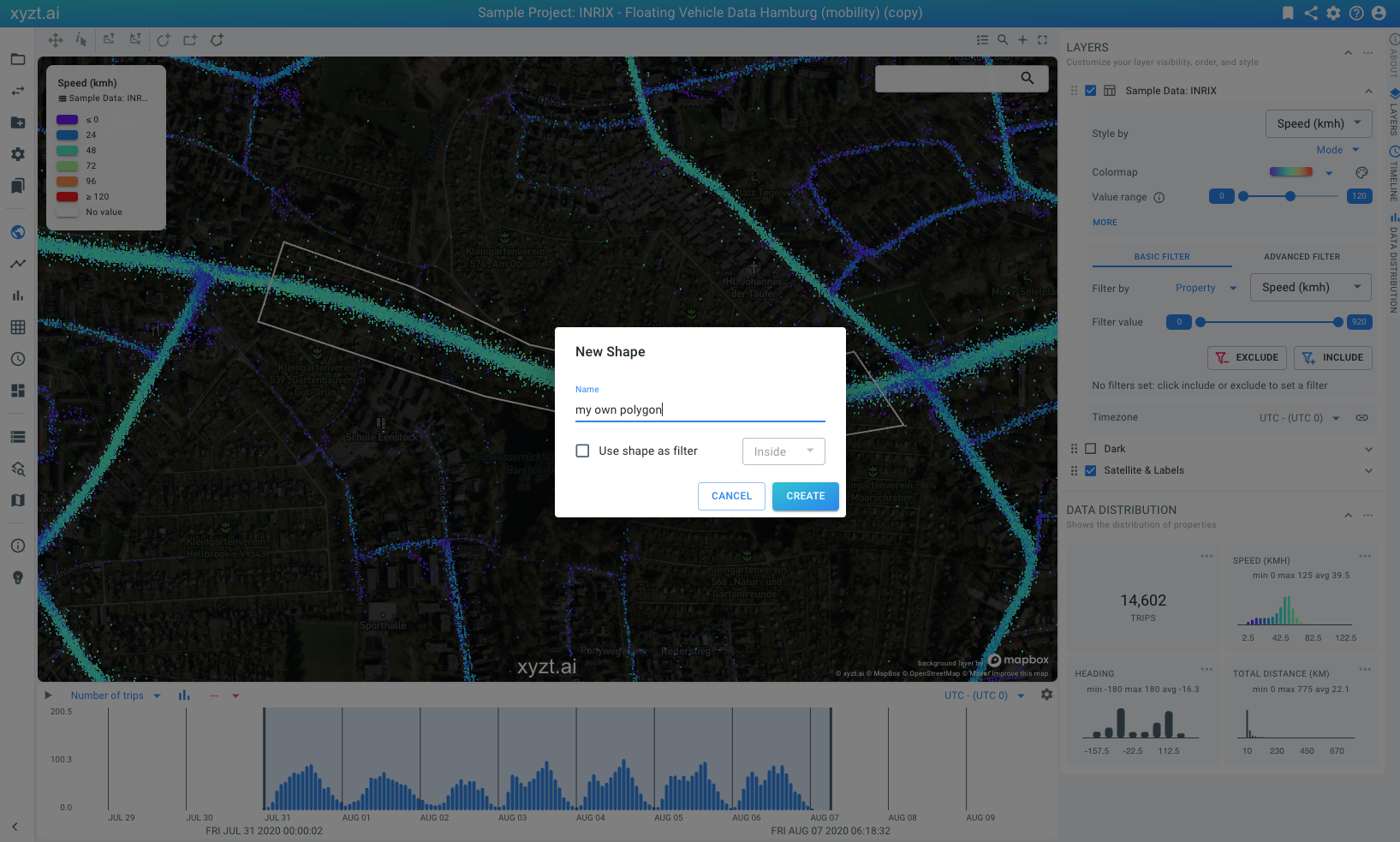
Figure 1. Drawing a polygon
This article explains how to create and draw your own shapes and use them for analysis on the different analytical pages. A drawing shape is a polygon created by drawing on the map using one of the shape creation controllers. You use such polygons to filter data about a specific area or to analyze data for a specific area, for example, a highway section, or an anchorage zone,…
As drawing polygons is done through the visual analytics page, it is strongly recommended to first read the introduction article which explains how the visual analytics page uses these filters.
|
Figure 1. Drawing a polygon
|
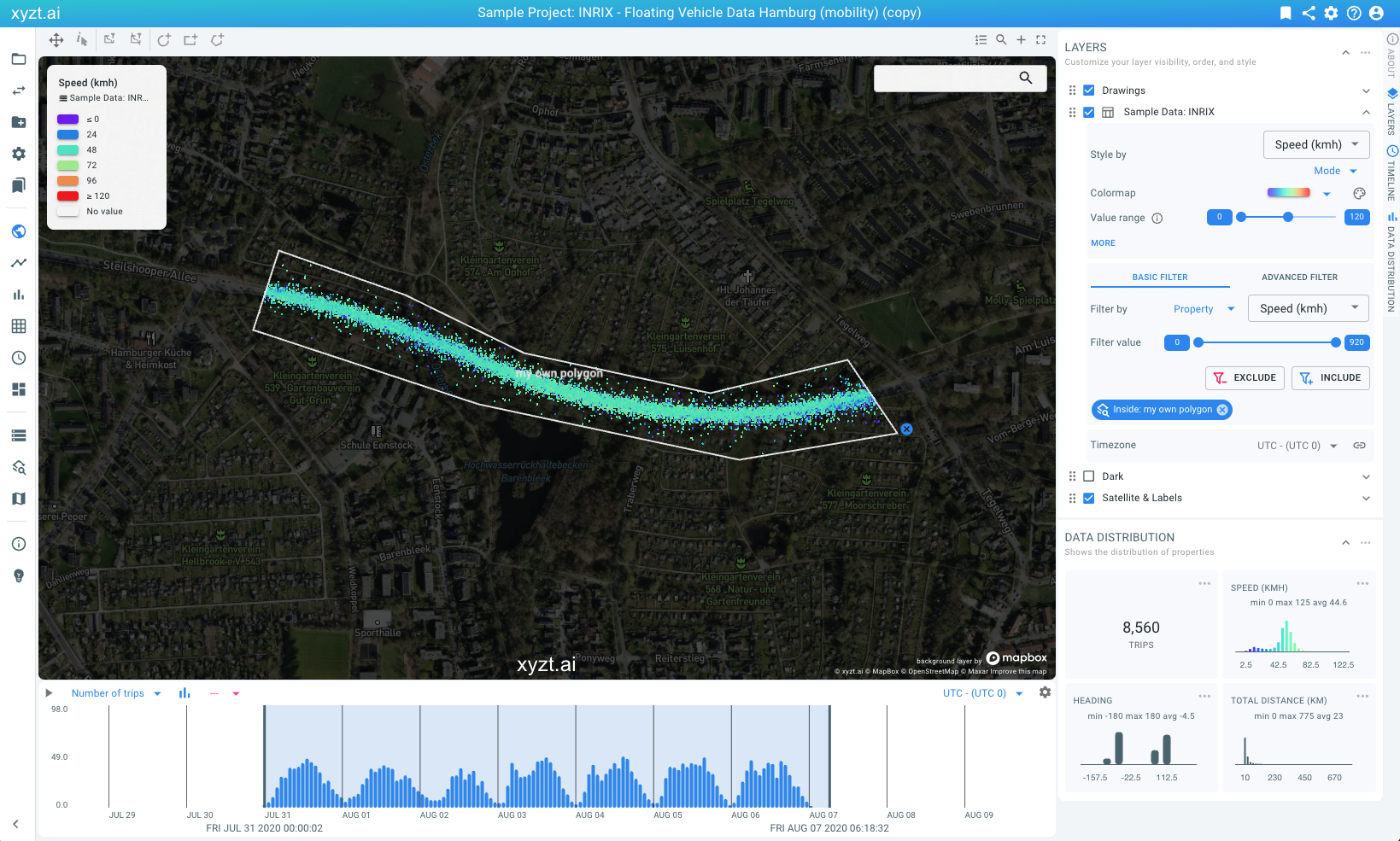
Figure 2. Using your own drawn polygon
|
To draw shapes, you need a project with a data set attached. Then follow these steps:
Open the visual analytics page
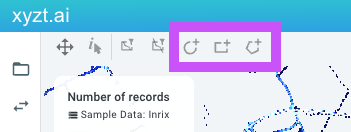
Select one of three shape creation controllers from the toolbar above the map. You can create a circle, a rectangle, and a polygon
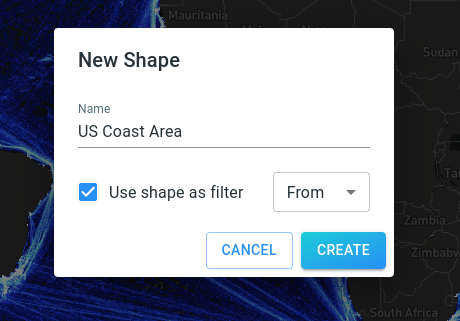
Click on the map to create the shape. When done, a dialog appears that asks for a name.
|
During shape creation you can navigate and zoom in and out on the map by holding the alt/option key while manipulating the mouse. In addition, when creating a polygon, you can remove the last point with the backspace/delete key. |
After you draw the first shape, a new layer with the name Drawing appears in the Layers panel. This layer corresponds to an automatically created layer that will also appear under
the project’s areas of interest layers.
When you delete the last shape of a drawing layer, the layer is automatically removed as well.
|
A separate drawing layer is created for each user. If two different users draw shapes for the same project, each will have their own drawing layer. |
For your own drawing layer, the layer controls on the Visual Analytics page provide a Manage shapes action. This opens a movable editor that can remain open while you pan and zoom the map.
The editor allows you to:
Rename shapes. The updated name is also used as the shape label and as the area name when the shape is used in analytics.
Order shapes. Move a shape to the front or back, or one position forward or backward. The order is stored in the shape style using the zOrder property. Higher zOrder values are drawn in front of lower values.
Style individual shapes. A shape can override the common drawing-layer line, fill and label style.
Zoom to a shape. Use the zoom action next to the shape name to fit the active map to the selected shape while keeping the editor open.
Delete a shape. The delete action asks for confirmation before removing the selected shape.
Drawing layers use the same common-style and feature-override paradigm as GeoJSON/SHP background and AOI layers. The Visual Analytics style of the drawing layer acts as the common style. A shape can override only the style parts it needs. If a shape has no individual line, fill or label style, that part falls back to the common drawing-layer style.
For example, one shape can define only its fill color while continuing to inherit the common line width, line color and label style from the drawing layer.
Changes are previewed immediately on the map. You can edit multiple shapes in one session; intermediate changes are kept when selecting another shape. Press Save to persist all changed shapes. Press Close to discard unsaved changes.
You can also open Manage shapes directly for a shape by right-clicking that shape on the map and choosing Manage shape. This action is available only for shapes in your own editable drawing layer.
|
You can manage the individual shapes only for your own editable drawing layer. When a drawing layer is attached to another project or otherwise becomes non-editable, its stored shape styles and order are still rendered, but the individual shape editor is not available. |
You can delete a shape in either of these ways:
Select the shape on the map and press the delete key.
Open Manage shapes, select the shape, and use the Delete action. A confirmation dialog is shown before the shape is removed.
When you delete the last shape in a drawing layer, the drawing layer is automatically removed as well.
You can delete an entire drawing layer as follows:
Navigate to the Areas of Interest
Click on the DELETE button on the card of the Drawing layer

After you delete a drawing layer, all shapes are gone. If you start drawing a new shape on the map, a new drawing layer will be created.
The drawn shapes can be used as spatial filters on the different analytics pages and as areas of interest, for example to compute trends for on the Trend Analytics page.
See here on how to use the shapes for spatial filtering on the Visual Analytics page.
The other pages where the shapes can be used as filters and as areas of interest are:
You can download the shapes drawn as a GeoJSON file using these steps:
Navigate to the Areas of Interest page
Click on the DOWNLOAD button of the respective drawing layer card
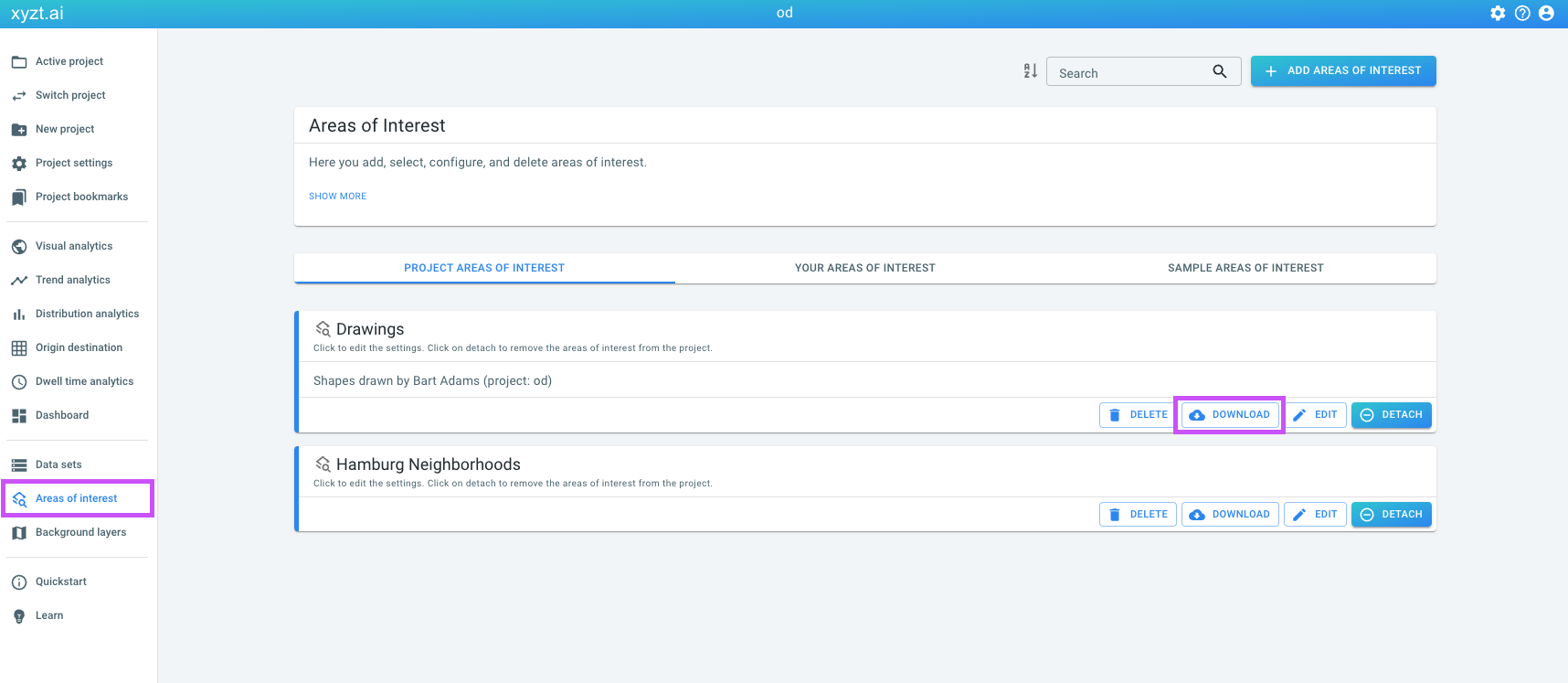
Your drawing layer can be attached and used in other projects. Similarly, drawing layers can be detached from a project. However, there are some caveats:
A drawing layer of project A, when attached to project B, will not be editable in project B. You can still create shapes in project B, but they will be created in a different drawing layer.
When a drawing layer of a project is detached, it becomes a regular areas of interest layer and becomes uneditable, even after re-attaching it to a project.